

Mortgage Software Modernization
Role:
Lead UX/UI Designer (Solo Designer in an Agile Pod)
Design System:
Salesforce Lightning Design System (SLDS) & Custom SLDS Web Components
Responsibilities:
UX Strategy, Information Architecture, AI-Augmented Workflow Mapping, Wireframing, Rapid Prototyping, Stakeholder Management
Timeline:
Two-Week Agile Sprints | Longitudinal Studies & Iterative Discovery
Platform:
Enterprise Salesforce Web Application (Internal Operations & Commercial Lending Portal)
Overview
Legacy internal commercial lending platforms were outdated, fragmented, and difficult to navigate. Critical intake and review workflows relied on disconnected software and manual spreadsheets that slowed operational staff and introduced severe processing errors. As loan application processing slowed, both internal underwriting teams and external commercial brokers expressed frustration. Internal teams struggled to manage higher volumes, while brokers hesitated to submit new applications due to high rates of dropped cases, opaque status tracking, and lack of clarity. A company-wide modernization was necessary to build a streamlined, unified Salesforce Lightning experience across the complete loan lifecycle.
The Challenge
Transform legacy operational intake into a user-centered digital workflow within Salesforce SLDS capable of handling higher volume with fewer errors. As the sole designer leading discovery and architecture, I set out to reduce manual overhead, integrate predictive AI triage patterns, and dramatically improve efficiency for internal reviewers and external commercial brokers alike.
Loan Assignment Made Simple: From Chaos to One Click
Project Summary
As the sole UX Designer embedded in an agile pod, I led end-to-end discovery and information architecture to design a modernized Salesforce Lightning (SLDS) application. By leveraging AI to rapidly synthesize complex user interviews and mapping legacy workarounds into intelligent workflow automation, we unified status visibility across internal teams and external commercial lending partners. Early research revealed that streamlining the underwriting case assignment workflow would yield the highest operational ROI, serving as the foundation for driving efficiency, eliminating copy-paste errors, and maximizing user satisfaction.
Design Goals
Modernize legacy internal software into a cohesive, native Salesforce Lightning experience.
Accelerate research synthesis and pattern extraction using AI tools to quickly translate user pain points into SLDS design solutions.
Establish continuous feedback loops with stakeholders and operations leads to drive iterative design improvements.

Success Metrics
25–30% faster task completion rate across high-volume loan queues.
40% reduction in manual assignment errors through automated capacity and specialty routing.
Streamlined research cycles, enabling rapid validation of wireframes across cross-functional teams.

The Process
Partnering with a cross-functional enterprise team, I led discovery to identify operational bottlenecks in legacy internal software and understand the workarounds employees relied on. As the sole designer, I conducted user research, mapped complex end-to-end workflows, identified system gaps, and validated new Salesforce Lightning solutions through iterative prototyping and usability testing with operations leads and key business stakeholders
User interviews, Journey Maps, and Personas
RESEARCH
User interviews, Journey Maps, and Personas
Ran observational studies and conducted targeted interviews across three core operational workstreams.
Leveraged AI tools for interview transcription and thematic clustering to rapidly extract pain points and accelerate research synthesis.
Created user journey maps and enterprise personas to align cross-functional product and engineering teams.
Presented architectural artifacts to executive leadership to secure early stakeholder buy-in.
Designed low-fidelity wireframes to establish the core information architecture in Salesforce Lightning (SLDS)
Mock-ups, Prototypes, Research Brief, UX Audits
DEVELOPMENT
Mock-ups, Prototypes, Research Briefs, UX Audits
Iterated on high-fidelity SLDS prototypes based on continuous stakeholder and developer feedback loops.
Incorporated feedback into design deliverables and aligned dynamic page components with engineering sprint backlogs.
Conducted accessibility and component audits to ensure strict consistency across the entire platform.
Planned longitudinal usability studies and coordinated user outreach with operations managers.
Usability Studies, Presentations, Deliverables
POST DEPLOYMENT
Usability Studies, Presentations, Deliverables
Continued user interviews as new workflow modules entered phased rollouts.
Maintained living journey maps and design system component specs to support ongoing product scaling.
Conducted structured usability sessions, presenting evaluative findings cross-functionally to drive continuous backlog prioritization.
Delivered end-of-quarter design documentation, including net-new Information Architecture (IA) flows and custom SLDS component specs.
Key roles in the Underwriting & Intake process
In this section:
Research Approach
Research Findings
Research Synthesis
Gathering insights internally and engaging key operational stakeholders was essential to driving discovery for our commercial lending software. This collaborative approach ensured alignment on business priorities, leveraged domain expertise, and established a user-centered roadmap that addressed both operational bottlenecks and technical requirements from the outset.
External Lending Partners:
Commercial Brokers: External partners who submit loan packages via PDF binders for internal review and underwriting approval.
Direct Lenders: Review and manage loan packages internally (Not included in this case study)
Internal Operations Team:
Underwriting Specialist: Reviews submitted loan packages and processes approvals.
Operations Administrator: Prepares case files, manages loan assignments, and tracks stagnant applications.
Data Analyst: Prepares operational reporting for leadership (Not included in this case study).
Operations Manager: Oversees daily workflow velocity and team capacity (Not included in this case study).
Research Approach:
I developed a targeted research framework to maximize insight while leveraging AI tools for rapid transcript analysis and theme extraction, focusing on three critical areas:
Understanding Personas & Intent: Mapped core user roles and responsibilities to gather workflow data efficiently without interrupting daily operations.
Uncovering Workarounds: Examined manual processes and shadow systems (like external spreadsheets) to uncover hidden bottlenecks and prevent design oversights.
Building Stakeholder Trust: Facilitated open, candid feedback sessions with operational leads to ensure our insights reflected true daily frustrations.
Through this approach, I ensured our development efforts were grounded in authentic user needs, capturing a comprehensive picture of the end-to-end workflow.
Research Findings:
Through AI-assisted transcription and thematic analysis of our user interviews, patterns quickly emerged. For this case study, we focus on the three core personas most impacted by intake bottlenecks:

External Commercial Broker
Role: Submits commercial loan packages via PDF binders for internal review and approval.
Key Pain Points:
Loan application statuses are opaque and cannot be tracked directly.
Communication is restricted to unmonitored system emails with long response delays.
Rejection notices (Information Requests) lack detailed explanations, creating repetitive back-and-forth messaging.
No direct visibility or communication channel with the assigned underwriter.

Underwriting Specialist
Role: Evaluates submitted loan packages and processes approvals.
Key Pain Points:
Forced to manage status changes across multiple legacy platforms.
No direct in-app messaging tool to clarify minor documentation issues with external brokers.
High workload and disjointed systems lead to misplaced emails and stale case files.

Operations Administrator
Role: Prepares case files, assigns loans to underwriters, and tracks stagnant applications.
Key Pain Points:
Manual, error-prone case preparation and file setup.
Relies on external spreadsheet trackers to log progress across disconnected platforms.
Copy-and-paste steps during case assignment introduce frequent routing errors.
Research Synthesis:
-
After my rounds of interviews, I took the information from all four different Home Ownership Centers (HOCs) and amalgamated the information to best represent the most common workflows. This was not easy, as each one runs autonomously and communication between them is limited. There was a misunderstanding between a Program Analyst and a Program Assistant. One HOC didn’t even have Assistants, only Analysts. So, I combined the two roles, thinking that their responsibilities intertwined so much that it would be best.
I was wrong; government stakeholders did not like this idea, so I had to go back and split them into two different personas and user journey maps. This was a sticky moment for me as the feedback was already combined into one affinity map. I had to comb through roughly eight interviews to discern when the participant was discussing job responsibilities that would be associated with the Assistant role versus the Analyst role.
Turning Systemic Inefficiencies into SLDS Opportunities:
By mapping these pain points side-by-side, we discovered that the case assignment step was the single greatest point of failure. Eliminating spreadsheet copy-pasting for Operations Administrators directly prevented stale cases for Underwriters and reduced turnaround time for Commercial Brokers.
Uncovering Workflow Redundancies
In this section:
Mapping The Problem
Operational Bottlenecks & Systemic Friction
Design Strategy
Mapping The Problem
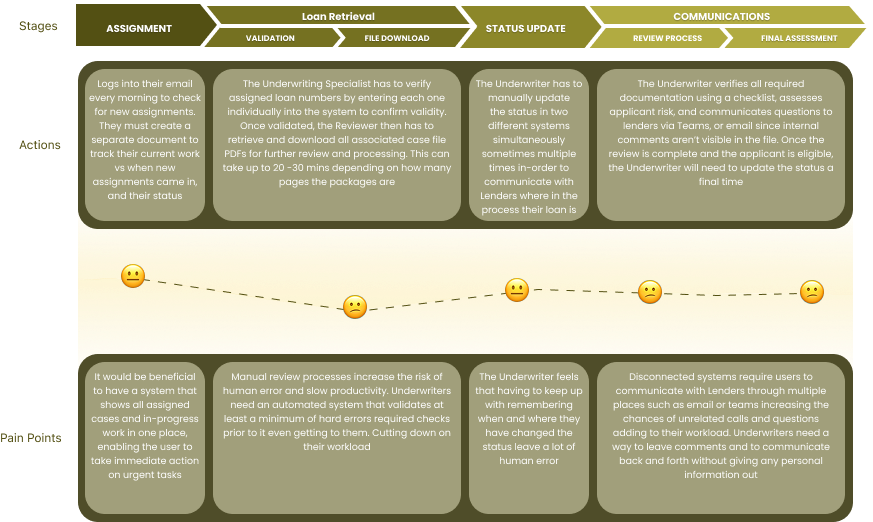
Mapping the end-to-end operational journey revealed three critical systemic bottlenecks between initial application intake and underwriter review:
Hotspot 1: Spreadsheet Data Silos
Operations Administrators manually copied loan metadata into external tracking spreadsheets, introducing a 15% error rate during case assignment.
Hotspot 2: Email & Communication Blind Spots
Rejection requests (Information Requests) occurred entirely over unmonitored system emails, leaving underwriters with zero visibility into whether external commercial brokers received or acted on missing document notices.
Hotspot 3: System Switching & Lost Context
Underwriting Specialists were forced to toggle across three separate legacy platforms to verify credentials, resulting in stale files and delayed processing times.
Design Strategy:
Faced with fragmented data silos and disconnected tools, I designed a unified Salesforce Lightning workspace that replaced manual, spreadsheet-based handoffs with an automated workflow—establishing a direct, traceable channel between internal underwriters and external lending partners that reduced processing errors and cut turnaround times.
Operational Bottlenecks & Systemic Friction
Designing & Validating the Solution
In this section:
Architecture & Component Strategy|
Features Delivered & Measurable Improvements |
Validating
Salesforce Lightning (SLDS) Architecture & Component Strategy
To build an intuitive enterprise workspace while adhering to tight sprint schedules, I established a clear component hierarchy. I prioritized native out-of-the-box SLDS components for core layouts and designed custom Lightning Web Components (LWCs) only where complex multi-step loan workflows required specialized UI patterns.
Queue Management & Triage
Native SLDS: Data Table, Filters, Badges
Custom LWC Extension: Inline Quick-Assign Drawer — Enabled Operations Administrators to reassign incoming loan packages in a single click without navigating away from the active queue.
Case Context & AI Synthesis
Native SLDS: Record Header, Tabs, Summary Path
Custom LWC Extension: AI Research & Exception Summary Widget — Highlighted critical missing documents and historical broker communications directly at the top of the record.
Broker Communication & Actions
Native SLDS: Activity Feed, Chatter, Modal Dialogs
Custom LWC Extension: Actionable Exception Request Modal — Standardized rejection notices into structured, actionable checklists for external commercial lenders.
Features Delivered & Measurable Improvements
One-Click Case Assignment: Replaced manual spreadsheet copy-pasting with dynamic SLDS record views, driving a 40% reduction in assignment errors.
Centralized Status Tracking: Gave external commercial brokers real-time portal visibility into case progress, yielding 25–30% faster task completion.
Contextual Action Item Messaging: Streamlined back-and-forth documentation requests between underwriters and brokers, eliminating stale case files.
Validating
Does it Work as Desired & Will it Work for All?
I established continuous feedback loops with operational leads and cross-functional team heads across regional offices. These recurring syncs provided critical visibility into core usability friction points, enabling us to rapidly iterate on SLDS component layouts before code handoff.
Accessibility & Section 508 Compliance
LWC Component Auditing:
Conducted rigorous screen-reader testing (JAWS/NVDA), keyboard navigation flows, and color contrast evaluations on high-density data tables and dynamic modal drawers before design sign-off.
Cross-Vendor Consultation:
Based on the rigor of our internal accessibility standards, I was contracted out to assist a partner consulting firm to audit and remediate Section 508 compliance across their external component libraries and enterprise software deliverables.
Next Steps & Reflections
With the assignment process redesigned and validated, the next phase focuses on scaling custom SLDS Web Components across adjacent lending modules. Thanks to our established research feedback loops, we prioritized high-impact backlog items based on direct user data, ensuring ongoing alignment between enterprise operational goals and user expectations.
Balancing Out-of-the-Box vs. Custom SLDS:
Leveraging native Salesforce Lightning components accelerated deployment, but knowing when to advocate for custom SLDS Web Components was critical for solving complex, multi-step enterprise workflows.
Proactive Cross-Functional Alignment:
Design cannot happen in a silo. I established early, proactive alignment loops with engineering leads to ensure design feasibility, component reuse, and smooth sprint handoffs without technical debt.
Knowing when to speak up and when to let things go:
Navigating enterprise constraints often meant balancing user advocacy with hard technical or business realities. During high-friction stakeholder sessions where ideal UX patterns couldn't immediately be implemented, I prioritized empathetic listening, ensured user pain points were documented in the product backlog, and advocated for iterative UX improvements across future sprint cycles.